
Concentration and diversification represent two contrasting strategies in investment management, each with its own set of principles and potential outcomes. Concentration involves investing a significant portion of a portfolio in a small number of high-conviction assets to pursue outsized returns. Diversification spreads investments across a broad range of assets, sectors, and geographies to manage risk and preserve wealth. Understanding how these strategies work together is essential for building and protecting long-term financial success.
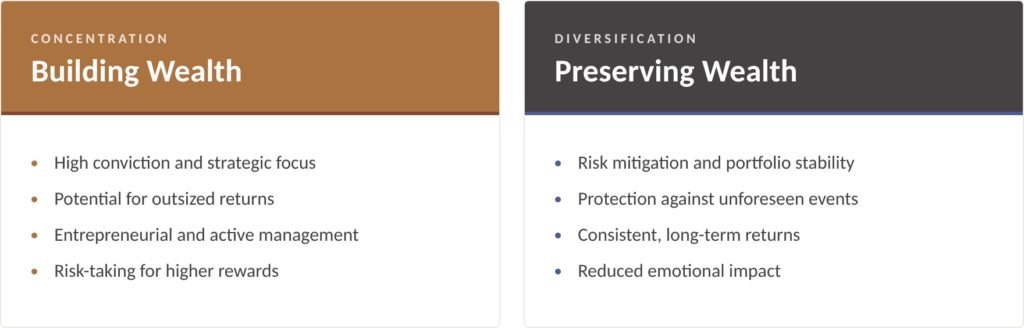
What concentration and diversification each contribute:
Key Takeaways
- Concentration builds wealth: a few high-conviction positions can deliver outsized returns — at the cost of higher volatility.
- Diversification preserves wealth: spreading across assets, sectors, and geographies cushions downturns and steadies long-term returns.
- It is not either/or — many investors concentrate to build, then shift toward diversification to protect what they have built.
- A diversified portfolio also carries an emotional benefit: less stress and fewer impulsive decisions when markets swing.
- The right balance is personal, set by goals, risk tolerance, and time horizon.
Concentration: Building Wealth
Concentration involves investing a significant portion of one’s portfolio in a small number of assets or asset classes. This approach is based on the belief that focusing on a select few high-conviction investments can lead to outsized returns.
1. High Conviction and Strategic Focus
A concentrated strategy starts with conviction. Rather than holding a little of everything, the investor commits meaningfully to the select few opportunities they understand best, and accepts that the portfolio’s results will be driven by those deliberate, focused choices.
2. Potential for Outsized Returns
The potential for outsized returns is a central theme in concentration strategies. When a concentrated investment performs well, the impact on the overall portfolio can be substantial. Successful bets on individual stocks or sectors can significantly accelerate wealth accumulation compared to a more diversified approach.
3. Entrepreneurial and Active Management
Concentrated portfolios are often associated with an entrepreneurial mindset. Investors who concentrate their holdings may actively manage their investments, seeking to capitalize on market inefficiencies or emerging trends. This hands-on approach can lead to proactive decision-making and responsiveness to market dynamics.
4. Risk-Taking for Higher Rewards
Concentration inherently involves higher levels of risk. However, this risk is viewed as a trade-off for the potential of higher rewards. Investors accepting concentrated risk are often willing to take on volatility in pursuit of substantial wealth creation opportunities.
Diversification: Preserving Wealth
While concentration is seen as a strategy for building wealth, diversification is regarded as a risk management tool to preserve and protect wealth. Diversification involves spreading investments across a broad range of assets, sectors, and geographies.
1. Risk Mitigation and Portfolio Stability
Diversification is designed to mitigate specific risks associated with individual assets. By holding a diversified portfolio, investors aim to reduce the impact of poor performance in any single investment on the overall portfolio. This risk mitigation enhances portfolio stability and preserves wealth during market downturns.
2. Protection Against Unforeseen Events
Unforeseen events, such as economic downturns, industry-specific challenges, or geopolitical events, can have a significant impact on individual investments. Diversification helps protect wealth by ensuring that losses in one area of the portfolio may be offset by gains in another. This broader exposure guards against the adverse effects of unforeseen events.
3. Consistent, Long-Term Returns
Diversification contributes to more consistent, long-term returns. While it may not deliver the same level of potential outsized gains as concentration, it aims to provide steady returns over time. This consistency is crucial for wealth preservation, especially during periods of market volatility.
4. Reduced Emotional Impact
Diversification can also help reduce the emotional impact of market fluctuations. Investors with well-diversified portfolios may experience less stress and anxiety during market downturns, as the overall impact on their wealth is cushioned by the performance of other, potentially more stable, investments.
Striking the Right Balance
The debate between concentration and diversification is not about choosing one over the other but finding an appropriate balance based on an investor’s goals, risk tolerance, and investment horizon. Some investors may opt for a hybrid approach, starting with concentration to build wealth and gradually shifting towards diversification to preserve and protect that wealth as their financial objectives evolve. A portfolio built this way is an outcome-based portfolio — designed around the goals the wealth must fund. That balancing work is the core of our wealth management practice.
Is It Time For A Family Office?
As families grow in wealth and complexity, managing finances, operations, and relationships becomes harder, raising the question of when to establish a family office.
Conclusion
In conclusion, concentration and diversification are complementary strategies that play distinct roles in the investment journey. Concentration can be a powerful tool for building wealth through strategic focus and potential for outsized returns. As Morningstar’s 2025 research on diversification confirms, broadly diversified portfolios have held up significantly better during volatile markets, underscoring diversification’s role as a risk management mechanism that preserves wealth by spreading risk and providing portfolio stability. The optimal approach depends on an investor’s unique circumstances, preferences, and objectives.
This content is intended for general educational purposes and does not take into account any individual investor’s objectives, financial situation, or needs.
The right mix of concentration and diversification is personal — set by your goals, risk tolerance, and time horizon. A conversation is the fastest way to find yours.
Wealth Concentration & Diversification FAQs
How Does Concentration Build Wealth?
Concentration builds wealth by channeling resources into a small number of high-conviction investments. When those investments perform well, the impact on the overall portfolio can be substantial, accelerating wealth accumulation compared to a more diversified approach.
How Does Diversification Preserve Wealth?
Diversification preserves wealth by spreading investments across multiple assets, sectors, and geographies. This reduces the impact of poor performance in any single investment and provides portfolio stability during market downturns.
Should I Choose Concentration or Diversification?
The choice is not one or the other. Many investors use a hybrid approach, starting with concentration to build wealth and gradually shifting toward diversification to preserve and protect gains as their financial goals evolve. The right balance depends on individual risk tolerance, goals, and investment horizon.
What Are the Risks of a Concentrated Portfolio?
A concentrated portfolio carries higher levels of risk because a small number of investments drive overall performance. If one position underperforms significantly, the impact on the portfolio can be substantial. This trade-off is accepted in pursuit of potentially higher rewards.
Why Is Diversification Important During Market Volatility?
During periods of market volatility, diversification helps cushion the impact of losses in any single investment. A well-diversified portfolio provides more consistent returns over time and reduces the emotional stress associated with sharp market fluctuations.