
Outcome-oriented investing is an approach that starts with clearly defined financial goals and then builds a diversified strategy designed to reach those outcomes over time. Instead of focusing only on beating a benchmark like the S&P 500, it emphasizes financial goal alignment, risk management, and more consistent compounding to support long-term wealth creation.
It’s human nature for people to view things through a “relative” lens. For instance, it is not uncommon for investors to look at their own portfolio performance relative to a popular equity benchmark (i.e., the S&P 500). It is one of the primary challenges for investors and their financial advisors to start looking at their portfolios on a more “absolute” basis.
The move away from portfolios designed to beat a benchmark to those that are designed to achieve a specific outcome has taken greater hold in financial planning and setting goals for one’s investment dollars. It was famed investor, Benjamin Graham, who said, “The essence of investment management is the management of risk, not the management of return.” While there is no clear-cut definition across the industry on what outcome investing is, this quote is its basic foundation. Essentially, a general definition is achieving a specific objective that solves for a specific need of investors. Investment performance, then, is based on progress relative to a specific outcome.
Key Takeaways
- Outcome-oriented investing measures progress against your goals — retirement income, education, a future purchase — not against an index.
- The math favors consistency: because returns compound, higher volatility drags on long-term growth even when average returns look similar on paper.
- Diversification deliberately narrows the range of outcomes — trading outsized upside for protection against outsized loss.
- A goals-first framework reduces emotional, fear-and-greed decision-making and the costs that come with constant trading.
- Lower expenses and tax efficiency compound quietly in your favor over a long horizon.
What Is Outcome-Oriented Investing?
At Legacy Bridge, outcome-oriented investing means creating customized investment solutions that target specific investor needs and measuring progress against those goals rather than a market index. This outcome-based framework focuses on whether a portfolio is on track to fund clearly defined objectives, such as retirement income, education funding, or a future purchase.
To pursue these outcomes, we diversify investment assets across several different asset classes, taking into account investor risk tolerance, time horizon, and specific goals, among others. While diversification helps to manage risk, it doesn’t come without a cost. By reducing the range of outcomes, you are ostensibly giving up the potential for outsized positive returns for the benefit of reducing or eliminating the potential for outsized negative returns. But the benefit of a more consistent return profile is, through compounding, the potential for greater long-term wealth — a basic principle of wealth management.
| Approach | How Success Is Measured | Primary Focus |
|---|---|---|
| Benchmark-based investing | Returns versus an index like the S&P 500 | Relative performance |
| Outcome-oriented investing | Progress toward specific financial goals | Goal alignment and risk-managed compounding |
The Mathematics of Consistency: Why Volatility Matters
Because investment returns compound over time, higher volatility can drag down a portfolio’s long-term growth, even when average returns look similar on paper. Managing volatility becomes more important as investors approach key goals and have less time to recover from large drawdowns.
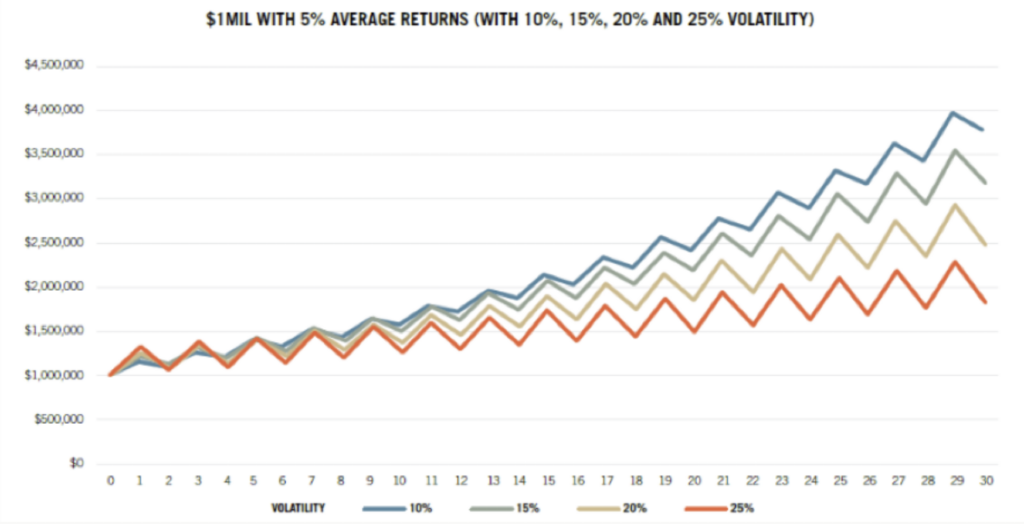
Chart 1. Volatility diminishes compounded returns over time. As volatility increases, a portfolio’s compounded returns over time decrease. And this gets riskier and riskier the closer you get to the end of your investing time horizon, as your portfolio has less time to recover from a downside event.
This approach is closely related to what many firms describe as goal-based investing or outcome-based investing, which focuses on aligning portfolios with specific life objectives rather than market benchmarks.
Key Benefits of an Outcome-Based Approach
Investing for outcomes, as opposed to simply trying to beat the market, can indeed lead to greater long-term wealth creation. This approach is grounded in aligning investments with specific financial goals and focuses on the broader picture of achieving desired outcomes over time. Here are several key reasons why investing for outcomes can be advantageous for long-term wealth creation.
Goal Alignment and Purposeful Investing
Investing for outcomes involves a deliberate and purposeful approach to wealth creation. By identifying and prioritizing financial goals, investors can tailor their investment strategy to meet specific needs, such as retirement, education funding, or purchasing a home. This goal-oriented approach provides a clear roadmap for wealth accumulation, instilling discipline and focus in the investment process. This kind of financial goal alignment keeps the portfolio focused on the outcomes that matter most.
Risk Management and Diversification
Investing for outcomes places a strong emphasis on risk management. Diversification, a fundamental principle of this approach, helps mitigate the impact of market volatility on the portfolio. A well-diversified investment portfolio spread across different asset classes can reduce the overall risk exposure, providing a more stable and resilient foundation for long-term wealth creation. By narrowing the range of potential outcomes, diversification can help manage risk and make the investing experience more resilient through market volatility.
Time Horizon and Compounding
Long-term wealth creation benefits from the power of compounding. Investing for outcomes often involves a strategic consideration of the investor’s time horizon. By taking a longer-term perspective, investors can capitalize on compounding returns, where earnings on investments generate additional returns over time. This compounding effect can significantly enhance wealth accumulation over the years, especially when the strategy is aligned with an appropriate time horizon.
Adaptability to Changing Circumstances
Financial goals and life circumstances can evolve over time. Investing for outcomes allows for adaptability in the investment strategy to accommodate changing needs. Regular reviews and adjustments to the portfolio ensure that it remains aligned with the investor’s evolving goals, providing flexibility to navigate various life stages and economic conditions.
Reduced Emotional Decision-Making
The pursuit of beating the market often involves active trading and responding to short-term market fluctuations. This can lead to emotional decision-making, driven by fear or greed. Investing for outcomes, with its focus on long-term goals, encourages a more disciplined and less emotionally charged approach. This helps investors stay the course during market downturns and avoid impulsive actions that could hinder wealth creation.
Lower Costs and Taxes
Constantly trying to beat the market through active management can result in higher transaction costs and tax implications. Investing for outcomes often involves a more passive and cost-effective approach, such as index fund or ETF investing. Lower expenses and tax efficiency contribute to higher net returns, supporting long-term wealth creation. Fees are one of the quiet drags on wealth — our piece on how investment fees erode long-term returns covers what to watch for.
Peace of Mind and Financial Well-Being
Knowing that investments are aligned with specific outcomes provides investors with a sense of purpose and peace of mind. This can lead to improved financial well-being, as individuals have confidence that their wealth is being accumulated with a clear objective in mind. Reduced stress and anxiety around investments contribute to a more positive long-term wealth creation experience.
Is It Time For A Family Office?
As families grow in wealth and complexity, managing finances, operations, and relationships becomes harder, raising the question of when to establish a family office.
Conclusion
In conclusion, investing for outcomes offers a holistic and purpose-driven approach to wealth creation. By aligning investments with specific financial goals, managing risks, and maintaining a long-term perspective, investors can enhance the potential for greater wealth accumulation over time. This strategy not only provides a roadmap for financial success but also promotes a disciplined and adaptable approach to navigate the complexities of the financial markets.
This content is intended for general educational purposes and does not take into account any individual investor’s objectives, financial situation, or needs.
If your investments are still judged only against an index, an outcome-oriented review can realign them with what they are actually for — retirement income, education, legacy, and the goals that matter most.
Investing For Outcomes FAQs
What is outcome-oriented investing?
Outcome-oriented investing is an approach that starts with clearly defined financial goals and then builds a diversified portfolio designed to reach those objectives over time. Progress is evaluated against those outcomes rather than against a market benchmark.
How Is Outcome-Oriented Investing Different from Benchmark-Based Investing?
Traditional strategies often focus on relative performance versus an index such as the S&P 500. Outcome-oriented investing instead focuses on whether the portfolio is on track to fund specific needs, such as retirement or education, emphasizing risk management and consistency.
Why does volatility matter for long-term wealth creation?
Because returns compound, large drawdowns can reduce the value from which future gains are calculated, making it harder to recover as an investor nears key goals. Managing volatility can help support steadier compounding toward long-term outcomes.
Who Might Benefit from an Outcome-Oriented Investment Approach?
Investors with clear long-term goals—such as retirement income, legacy planning, or funding education—may find that an outcome-based framework provides greater clarity, discipline, and alignment between their portfolio and their financial objectives.